You Reap What You Sow – System Choices Also Build Organizational Culture
Every system choice carries values, assumptions and beliefs that shape organisational culture.
· Janne Ruohisto
When a company or organisation decides to acquire a new information system, the focus is on its technical features. Too rarely do we stop to ask what values, assumptions or beliefs lie behind the system's functions and features.
This has far-reaching consequences.
Especially when the system concerns people, skills or learning, the choice is about much more than technology.
Information systems also carry values, beliefs and assumptions – and these directly shape organisational culture. Culture, in turn, has enormous strategic significance: it can decide whether an organisation succeeds in its goals.
Sanna Wenström sums up this perspective in her article The Emperor's New Glasses – The Knowledge Base of Humanity in Organisational Development (in Finnish):
"You cannot build a stone house out of timber, nor the other way round."
Human resource information systems (HRIS) are among an organisation's most important building blocks and a concrete expression of its culture.
They are not neutral technical decisions but messages about the kind of culture we want to reinforce and how we see the people in our organisation.
They are not just tools for making work more efficient and saving time, but increasingly strategic choices that steer the organisation's development for years to come.
That is why the building blocks must be chosen with care – replacing them later is difficult, slow and expensive.
Herein also lies a great opportunity: although information systems alone do not create organisational culture, they can significantly support the culture's development in the desired direction.
The essential question then is: does our system choice take us in the direction we want to go – or does it tie us to the past?
Our view of people guides our choices – whether we realise it or not
Our view of people quietly guides how we think about people, how we lead – and which systems we choose.
A little over ten years ago I was attending an HR Next Practice seminar when the discussion turned to a familiar topic: where to find motivated employees – and, between the lines, how to most easily get rid of those who are not.
I asked for the floor and put a question to the audience of a hundred: "How many of you want to be motivated in your own work?" Everyone raised their hand. I suggested that perhaps we should not worry so much about where to find motivated employees. It would matter more to stop and listen to employees about what motivates them.
Later I was presenting at a large company how easy Skillhive makes it to make visible not only skills but also the wish or interest to develop further in a given skill. The HR director replied: "We can't ask employees that." When I asked why, he explained: "Employees might assume that we would have exactly the roles they want to offer them."
At another company we considered whether a certain process could be built more on trust and openness. The idea was rejected because management estimated that around 3% of employees could not be trusted. I understood the logic – but I was left wondering what the remaining 97% of employees thought of the decision. On whose terms, and for whom, are systems ultimately chosen?
These stories show that our view of people is not just a mental model but an invisible compass that guides our choices every day – including when we make decisions about systems and technologies.
Choose a system that supports the culture you are aiming for
When choosing an information system, stop and assess: what values, assumptions and beliefs lie behind it? Is the system built on trust or on control? Does it see people as self-directed and eager to learn – or as subjects to be monitored and directed?
Both trust and control have their time and place. But a system built solely on control can stifle trust before it even has a chance to emerge.
Trust is not just a "nice thing"; it is also an engine of business. Organisations with high trust often report better engagement, lower turnover and faster innovation, because people dare to share their skills and try new things.
Skillhive supports a modern, community-driven, trust-based organisational culture
Behind Skillhive is a view of people that can be described as humanistic or holistic (in Finnish).
We believe that everyone has strengths, but no one knows everything. We believe that people want to be motivated in their work and to do it well. One of the basic human needs (in Finnish) is the desire to belong and to be worthy of trust.
We also understand, however, that trust does not appear out of nowhere – and certainly not at the push of a button. Trust cannot be demanded; it has to be earned, especially where it has once been lost.
That is why we approach each customer's situation with care for users' sense of safety (in Finnish).
We do not believe in throwing people into the deep end of the pool to see who survives. Instead, where needed, we start in the shallow end and move step by step towards deeper practices and wider visibility.
Skillhive's adaptability makes it possible to progress while respecting the organisation's own culture. Skills do not have to be made visible to the whole organisation at once; visibility can be built in a controlled way, reinforced by experience. In this way, trust in the new way of working can grow gradually, through experience and example – "Look, Pertti made his skills visible to others, and nothing bad happened. He's even smiling contentedly."
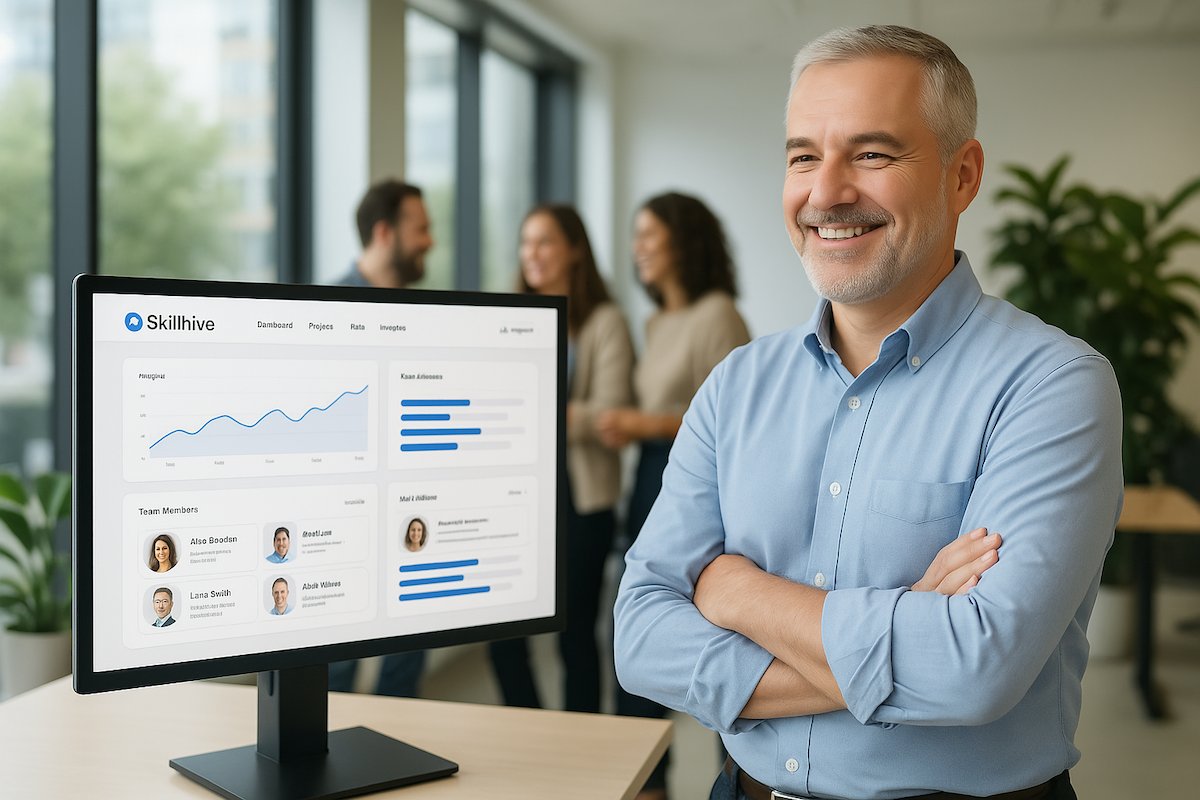 I asked an AI (ChatGPT) to create an image of Pertti smiling contentedly after making his team's skills visible with Skillhive.
We have discussed these topics with every one of our customers. For some, making skills visible has felt more unfamiliar than for others. In some organisations we have together arrived at solutions where skills are visible only to the person themselves and their manager.
In others we have taken a controlled step towards a more open way of working. What all our customer relationships have in common, however, is that not once have the fears and concerns associated with these steps come true. On the contrary: our customers have reported that adopting Skillhive and making skills more visible has not only brought efficiency gains – it has also felt good.
Even if your organisation is not "modern", it can become one
When I present Skillhive to new customers, I often encounter the concern of whether its practices, based on trust, openness and community, fit their organisation's everyday life.
It is true that a leadership culture does not change overnight – nor at the push of a button. Nor do practices transfer as such from one organisation to another.
This does not mean, however, that the organisation has to be ready.
A modern organisation is not a starting point but a goal that can be pursued with determination. Skillhive's customers do not choose us because their organisation is already ready, but because they want to move towards a culture where:
- Trust is at least a goal, even if not always the starting point.
- Collaboration and knowledge sharing are part of everyday work.
- Leadership builds sustainable growth – by strengthening people's skills, wellbeing and sense of community.
Choosing a system is also a cultural act
Technology by itself does not change an organisation, but it can either support development or slow it down.
That is why I always recommend pausing for a moment to ask:
- What view of people does the system support?
- Does it build the culture we want to develop?
- Does it support our journey towards our goals?
If you want to continue the conversation
If these thoughts resonate and you would like to reflect on system choices from the perspective of leadership culture, feel free to send me a message – I am always happy to exchange ideas on the subject.