Skills Management 2025
The future of skills management.
· Janne Ruohisto
Skills management is like a Rubik's Cube: as soon as one side is in place, two others are scrambled again. Why? Because skills as a phenomenon are wickedly multidimensional – and yet they are exactly the capital on which tomorrow's competitiveness is built.
In this article we:
- Dig into the pain points of traditional competency frameworks
- Reflect on the trend of breaking work down into tens of thousands of skill atoms.
- Show how Skillhive combines the best of both worlds – and leaves needless bureaucracy in the past.
Spoiler alert: the solution is not "either-or", but "both-and".
Why do traditional competency frameworks stall?
The competency models built back in the 1990s offer good lessons: a shared language, standardised roles and job descriptions, and consistent definitions and metrics for the skills each role requires. But the world is no longer the same. Digitalisation, distributed work and constantly evolving technology all erode the power of generic, static and hierarchical models. When they are rolled out, organisations often end up with a model that is outdated the moment it is born.
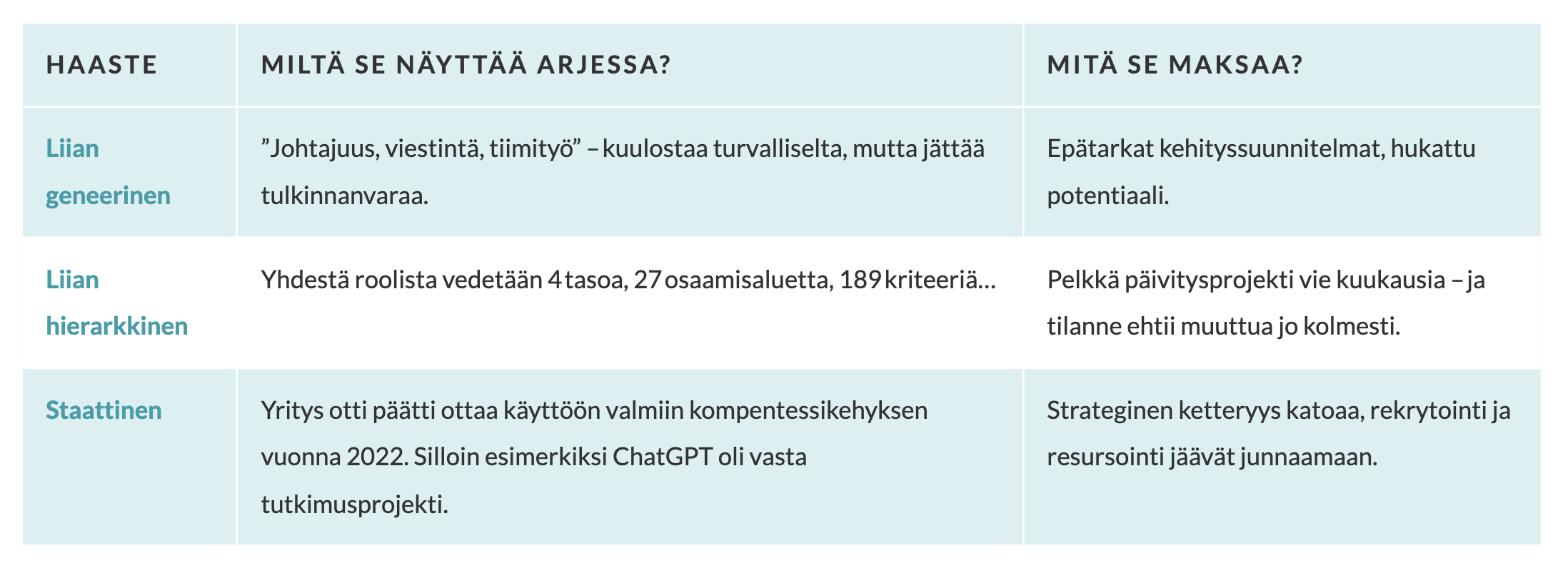
Sound familiar? You are not alone. Organisations around the world struggle with the same trolls.
The "half-life" of skills – a fact that tightens the deadline
According to Harvard Business Review (2023), the average half-life of skills is now less than five years, and in some technical fields as short as two and a half years. If your framework is updated less often than quarterly, it is already late.
The skills-based organisation (SBO) – cure or new symptom?
When the bars of competency frameworks start to tighten, the pendulum swings to the other extreme: break work down into atoms and replace the competency model with a skills taxonomy.
Global consultancies and HR system vendors have together painted a new vision: the skills-based organisation (SBO). When permanent roles are replaced by agile projects and gigs, and AI promises to pick the perfect person from a metadata sea of 50,000 skills in seconds, the horizon promises a better employee experience, fairer pay, continuous learning and lightning-fast internal mobility.
Perfect on paper. But what about grey everyday reality?
- An employee opens the system and faces lists of hundreds of skills with no clear structure ("Facilitating Scrum ceremonies", "Running an OKR workshop", "Anchor links in Figma prototypes"). Are these all equally relevant, what do they relate to – and who has time to assess them all?
- A project manager creates a gig: "We need someone with Asana Portfolio management at level 4." Will they find one? Maybe – but what about the person with Monday.com portfolio experience, higher motivation and a genuine desire to develop? And how was that skill supposed to be developed again?
- The HR data team sweats over maintaining the skills taxonomy: what is the difference between Data Analysis and Data Analytics? Or Prompt Engineering and Generative AI Prompting? Which broader areas do they belong to?
Without a clear understanding – who, what, for whom and above all why – the SBO's skill atoms quickly turn into a new administrative monster.
The old problem returns: too generic versus too fragmented.
Who has the expertise and time to help HR manage skills? Why is it even HR's job? What is the ultimate purpose of the SBO exercise? Are we missing the forest for the trees?
At worst, the "emperor's new clothes" do not fix the original sin of HR systems: people are seen merely as resources – and then we lose what is best in us: motivation, curiosity and the desire to grow – together.
Skillhive – a third way that combines structure and agility
Generic vs granular – in this tension, Skillhive does not pick sides. It merges role-based thinking and skills-based data into one living ecosystem where both perspectives get along. The result is a system that responds to the needs of a changing everyday reality while keeping a strategic backbone.
How does it work in practice?
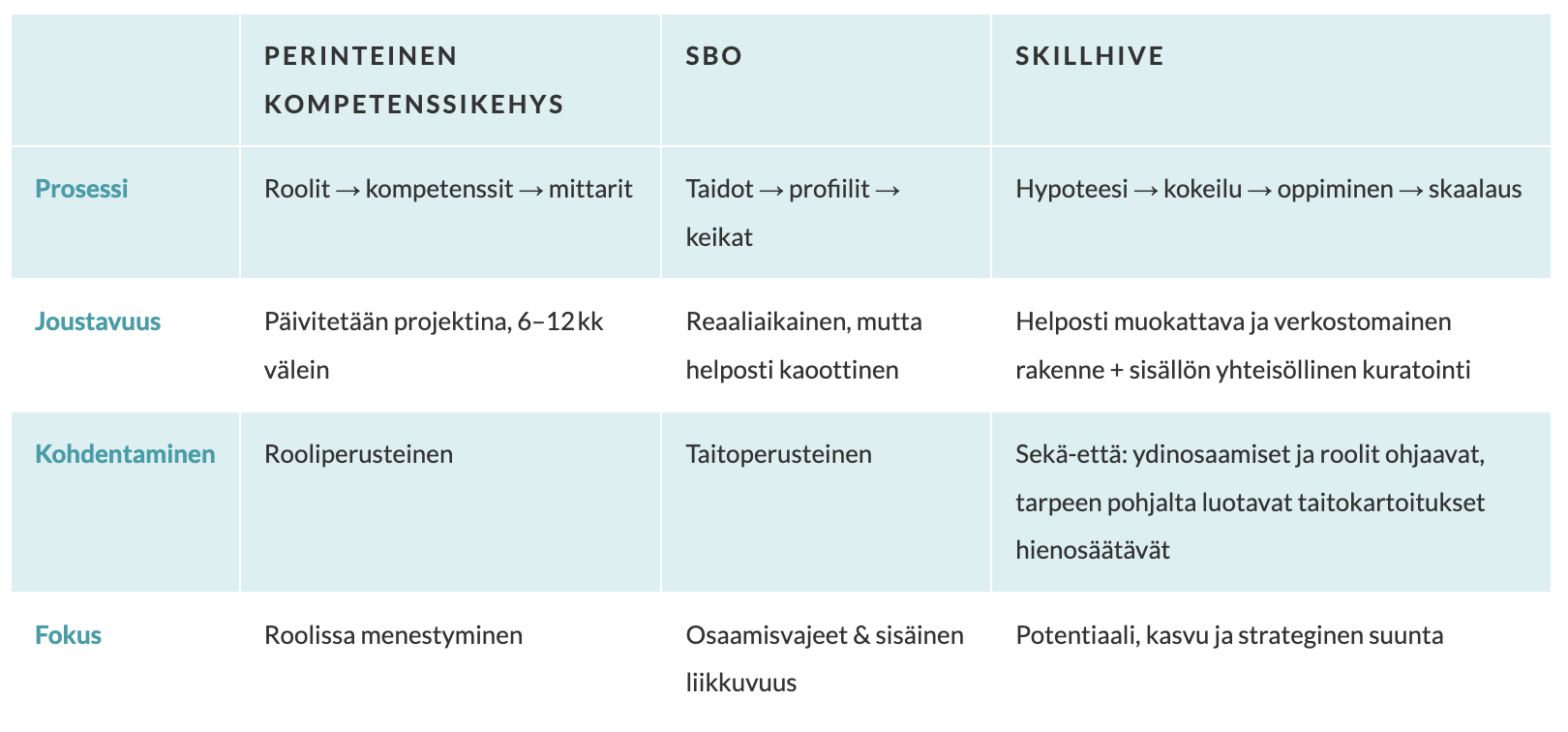
6 ways Skillhive sets skills free
- Starts from what exists, scales boldly
- Skillhive does not create models set in stone. We encourage you to build a quick first version, test it in teams, gather feedback and adjust as needed. As trust grows, scaling is easy. "Version 0.3 in testing" always beats "Version 1.0 someday".
- Connects leadership strategy with teams' everyday work
- Leadership follows organisation-level capabilities (e.g. Green transition), while teams define their own concrete skill needs.
- AI can assist, but people decide
- AI suggests, but the decision stays with the experts. This ensures skill descriptions are high quality, context-specific and needs-driven.
- Structures skill areas and skills as a network, not a rigid hierarchy
- A single skill can relate to several skill areas, groups or roles. Skills are easy to add, edit and combine, and their management can be shared among teams or experts.
- Puts motivation and growth potential at the centre
- Skillhive always asks: Are you interested in developing? This captures future potential, not just yesterday's skills.
- Recognises tacit knowledge and validates skills based on evidence
- An experienced professional cannot always put deeply ingrained expertise into words. It may be easier for them to name what they cannot do than what they are good at. Skillhive's Highlight swarms reveal tacit knowledge and turn it into evidence-based "skill signals" that confirm expertise, using the power of stories and peer feedback.
Skills management 2025 – how to get started and stay ahead
- Check your starting point
- – Do you have a dusty Excel, a giant taxonomy or a blank slate? Make a quick heat map: what is actually alive and what exists only in PowerPoint.
- Start with an educated guess, not a perfect model
- – A pilot of a couple of weeks is enough to validate the model. When editing is easy, the pursuit of perfection loses its grip.
- Link it to strategy
- – Choose 2–3 core skill areas that drive your most important goals. The rest builds around them almost by itself.
- Prioritise the human side
- – Design the process for people, not for the report. Define the user journey: how a team member updates their skills and what they get in return.
- Pilot, learn, repeat
- – Roll out Skillhive to one team as a guided project, collect the lessons and expand to the next.
- Rocket-fuel the culture
- – Technology is the engine, but culture is the fuel. Highlight successes and celebrate first-mover teams.
Remember: a perfect model is never finished. The best model is the one that keeps updating.
Ready to take skills management into 2025? Let's book a 30-minute demo and see live how Skillhive brings roles and skills into the same view without bureaucratic baggage.
Book a demo now.
Because skills belong to people, not to administrative bureaucracy.